
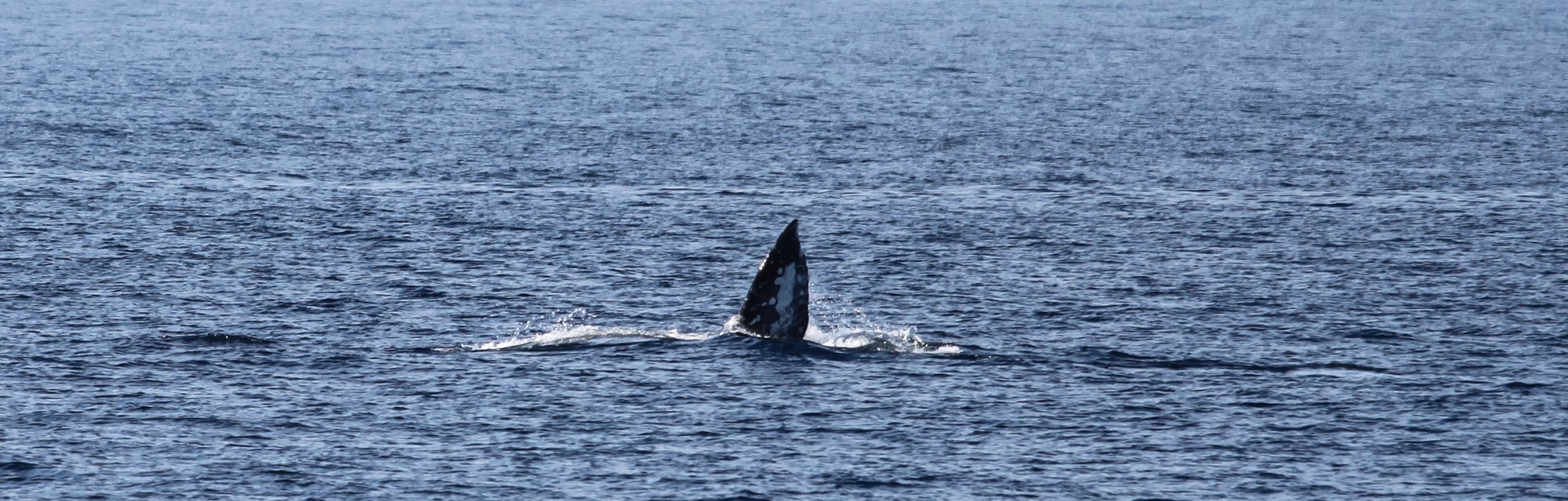
A humpback whale surfacing offshore at Los Chonchos, its tail above the water

The Chonchos Journal · Wildlife

When is whale season in Puerto Vallarta?

Humpbacks are in the bay from the end of October to late March, and peak from the middle of December to the middle of February. Here is what that looks like month by month, and what is in the water the rest of the year.

The short answer

Humpback whale season on this coast runs from the end of October to late March, and is at its most reliable from mid-December to mid-February. You do not need a tour: the channel the whales use runs straight out from the shore at Los Chonchos, and the bungalow decks face it. Most of what you see is a back, a blow or a tail — a full breach happens from time to time, not on cue.
Month by month

Whales are wild animals and nobody can promise you a sighting. What follows is what guests report, season after season.

This is wild nature, not a show. Nothing here is fed, baited, scheduled or guaranteed. These are the patterns guests report season after season — the animals come and go on their own terms, some stays are quieter than others, and if you are not watching the water you will miss things.

January Peak The thick of it. Guests routinely report ten or more in a day.
February Peak Peak runs to about the middle of the month, then begins to ease.
March Tailing off The last of the humpbacks. Still seen, less often.
April No humpbacks The channel empties of whales. Everything else carries on.
May No humpbacks Warm water, calm mornings, and nobody about.
June No humpbacks Rainy season building. Snorkelling visibility improves.
July No humpbacks Green season. The jungle is at its loudest.
August No humpbacks Warmest water of the year.
September No humpbacks Quietest month for visitors. Best underwater visibility.
October First ones The first humpbacks appear at the end of the month.
November Building Numbers climb through the month.
December Peak begins From about the middle of December it is reliably busy.

Why you shop before you go

Nothing is sold at Los Chonchos. No shop, no bar, no vending machine, no reception desk with a jar of instant coffee. Every bungalow has its own kitchen and guests cook what they bring.

Puerto Vallarta makes it easy. There are local market shops all over the city for fruit, vegetables, fish and tortillas, and big retailers — Walmart, Costco, Soriana and La Comer among them — for everything else, including the things that are not food.

This is not an inconvenience to be endured so much as the thing that makes the week feel like yours. Nobody sets a mealtime. Nobody rings a bell.

What is already in the kitchen

You are not starting from nothing. Every bungalow has a gas stove, a fridge (gas or solar depending on which one you take), a French press, pots, pans, crockery, cutlery and running mountain spring water. Each has its own dining deck with an ocean view.

One five-gallon jug of filtered drinking water comes with the bungalow. Each additional jug is 200 pesos. The jug may be part full when you arrive — if a previous guest left most of one, it stays for you — and we refill on request.

  • Gas stove
  • Fridge — gas or solar
  • French press
  • Pots, pans, crockery, cutlery
  • Running mountain spring water
  • Filtered drinking water on a dispenser

The three things guests always wish they had brought more of

Butter, cooking oil and seasoning. Every season, without fail. They are the things people assume will be there and are not, and they are the difference between cooking well and cooking grimly.

Buy more than you think you need of all three, and bring ground coffee — there is a French press in every bungalow and nothing to put in it.

What travels, and what does not

Everything you buy spends about an hour on open water and then gets carried up a beach. Pack accordingly.

A cooler or cooler bags for anything perishable. Soft bags rather than hard cases. Nothing in glass that you would mind losing — and remember glass has to be separated and taken out again by boat.

  • A cooler or cooler bags for the hour on the water
  • Preferably soft bags rather than wheels — there is sand at both ends. Hard cases do travel, and plenty of guests bring them
  • More pesos than you think you need; no ATMs, no card machines
  • Snacks for the days you cannot be bothered to cook

What Chimo can cover

Chimo is the next village along, ten minutes by boat. It has two small stores with a limited but real selection — vegetables, tortillas, ice, cold beer and some meat — though particular items are not always in stock. Fresh fish comes from the pescadería or from locals in the town rather than the stores. There are also two restaurants.

Anything from the stores can come over by boat and be delivered to your bungalow. The staff commute from Chimo every day, so if it is not urgent they will often simply walk it in the next morning. Running out is an inconvenience, not a crisis.

If you would rather not cook at all

A local cook will come to your bungalow with all the ingredients and cook in your kitchen while you do nothing at all. Same day is usually fine, more notice is better.

A meal cooked in Chimo can also come over by boat and arrive at your deck. Or take a boat across and sit down in one of the two restaurants — ten minutes each way, or fifty minutes on foot over the trail if you would rather earn it.

What is here when the whales are not

April to September has no humpbacks and everything else. It is also the warmest water and the best underwater visibility of the year, because the low and rainy seasons are clearer than the dry winter months.

Mobula rays

Year-round

They come clear out of the water and land flat with a crack you hear from the deck — at dawn, at noon, at four in the afternoon.

Dolphins

Year-round

Loose pods run the coast, usually working past the point in the morning.

Giant manta rays

If you are lucky

Several meters across, and unmistakable when they clear the water. Not every stay, and not predictably.

Sea turtles

Nesting season

They move through the shallows and come up to nest on sand almost nobody walks on. Hatchlings cross the beach to the water.

Pelicans and frigatebirds

Year-round

Pelicans work the rocks offshore in formation. Frigatebirds hang above the point.

Iguanas

Every day

They take the warm end of the deck in the late morning and stay. Entirely unbothered by you.

Jungle birds

Year-round

Chachalacas on the railing, woodpeckers on the trunks, parakeets and parrots across the canopy at dawn and dusk.

Hummingbirds and butterflies

Year-round

Straight through the bungalow, in one open wall and out the other, all day.

Land and hermit crabs

Every day

Vegetable scraps over the rail and the land crabs deal with them in front of you.

Seals

If you are lucky

Occasionally one turns up along the rocks. Rare enough that we will not promise it.
Where to watch from

Every bungalow at Los Chonchos faces the channel. There is no boat to board, no early start and nothing to book. Guests see them from the deck, from the hammock, and from the kitchen while the kettle is on.

Los Chonchos sits on the Cabo Corrientes coast, an hour by water taxi from Boca de Tomatlán and about ninety minutes in all from Puerto Vallarta. There is no road in.

“Propane, solar, Starlink, and gravity-fed spring water provide all of the comforts of home.”