What "open-sided" actually means
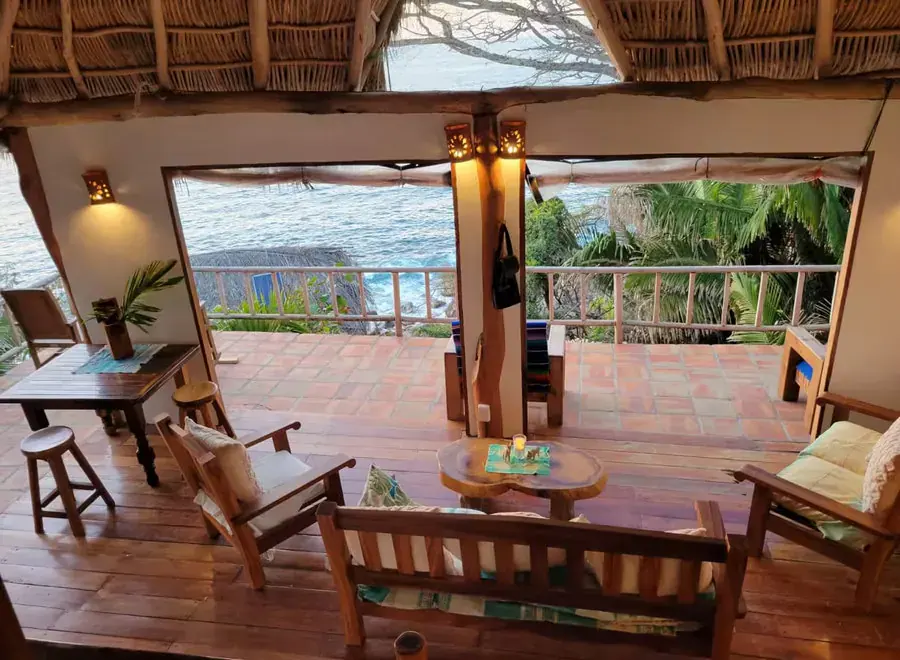
A palapa is an open-sided, palm-thatch house. The roof is thatch, the floor is terracotta, and the wall facing the ocean simply is not there. The surf is the sound in the room, all night, every night.
It is not camping. There is a private kitchen, a hot shower, a flush toilet and a bed with linen. It is a house that happens to be open on one side.
What comes in
Hummingbirds, straight through the room — in one open wall and out the other, close enough to hear. Butterflies all day. Chachalacas on the railing. An iguana taking the warm end of the deck in the late morning and refusing to move.
Guests regularly say they saw more animals than people. This is the part nobody expects to love and almost everybody does.
Insects, honestly
This is jungle, so there are insects — but far less than most people expect, and the mosquitoes are seasonal. They appear with the rains, from around the middle or end of June, and tail off through October. Outside that window there are few, if any.
Bring repellent regardless. It is not only mosquitoes: sand flies, the no-see-ums, are the ones that catch people out, and there is nowhere here to buy anything to keep them off.
Bark scorpions exist on this coast, as they do all along it, and are very rarely seen. People have lived here for years without a single sting. The usual habits apply: shake out shoes, clothing and towels, and keep a flashlight by the bed. A sting is painful but almost never dangerous.
Vegetable scraps go over the rail to the land crabs, which keeps food waste out of the bungalow entirely. Meat scraps and bones go into the ocean, so they do not draw animals up to the houses.
How you actually sleep
Under a mosquito net, with the sea air moving through. Most guests say they sleep better than they do at home, and put it down to the sound and the absence of anything to wake up for.
There is no air conditioning and nothing that plugs into the wall and makes heat. A USB rechargeable fan is fine on the solar system; a plug-in fan is not. The open side does most of the work.
- Mosquito nets over the beds
- No air conditioning — the open wall and the sea breeze instead
- A USB rechargeable fan works; a plug-in one does not
- The paths are unlit, so everyone needs their own flashlight
Who should think twice
Anyone who needs a sealed, air-conditioned room to sleep. Anyone who is genuinely frightened of insects rather than mildly wary of them. Anyone who would find an iguana on the deck a problem rather than a story.
If you are not sure, write and ask. We would far rather talk you out of it now than have you discover it after an hour on a boat.